- 48 Hours / 8 Weeks
- - In-class, Distance, Combined
- Certificate
Gain hands-on understanding of fundamental accounting principles, bookkeeping procedures, budgeting, and financial reporting tailored specifically to hospitality settings. Learn how to manage revenues, monitor food and beverage costs, control inventory, oversee payroll, and analyze operating statements such as income statements and balance sheets. Explore internal controls, cash management, and compliance practices that ensure financial accuracy and accountability.
Together with Eton, begin building the financial expertise needed to support sustainable growth and operational excellence in the dynamic world of hotels and restaurants.

Program Advantage
- 48-Hour In-Depth Instructor-Led Training
- Comprehensive Learning Modules
- In-class, distance and via blended learning
- Guided Mentorship by Industry Experts
- 24/7 Support
At Eton College, we pride ourselves on delivering high-standard education in Vancouver, Canada. For more than 20 years, we have been proud to help 83% of our graduates to land their dream careers through our various PTIRU-certified and industry-relevant upskilling programs, specializing in Business Management, Travel and Tourism Management, Hospitality Management, Flight Attendant Preparation, Information Technology, Airport Operations, Construction, Public Administration, Healthcare, Elderly Care and Communication training.
-
Overview
- Modules
- Fees
- Admission
- Career Services
- Admission
- Career Services
PROGRAM DESCRIPTION
This course presents basic financial accounting concepts and shows you how they apply to the hospitality industry. This course incorporates the most recent formats, information, and schedules from the newly-published Uniform Systems of Accounts for the Lodging Industry, Sixth Edition. Each textbook chapter also includes five problems to give you practice using accounting information.
LEARNING OBJECTIVES
Upon completion of this course the successful student will have reliably demonstrated the ability to:
- Describe the accounting process and the roles that accountants play in collecting and presenting financial information.
- Define the major classifications of accounts (assets, liabilities, equity, revenue, and expenses) and describe specific accounts found within each classification.
- Understand the correct application of debits and credits by analyzing business transactions for a variety of accounting situations.
- Discuss the basis of the double-entry accounting system and identify the normal balances of the various types of accounts.
- Describe the posting, journalizing, and closing processes.
- Identify the purposes and characteristics of specialized journals and subsidiary ledgers.
- Discuss the advantages and disadvantages of the sole proprietorship, the partnership, the corporation, and the S corporation, and describe and compare accounting procedures for each.
- Discuss generally accepted accounting principles and explain the usefulness of each.
- Distinguish between cash basis accounting and accrual accounting.
- List procedures that help ensure internal control of a firm’s cash.
- Discuss how hospitality firms account for bad debt losses.
- Describe accounting procedures involved in notes receivable and notes payable.
- Discuss methods of controlling and accounting for inventory.
- Identify and define the major classifications of adjusting entries reversing entries.
- Define ten steps of the accounting cycle.
- Describe the balance sheet, the income statement, the statement of owners’ equity, the statement of retained earnings, and the statement of cash flows, and discuss the purposes of each.
- Identify the uniform systems of accounts relevant to the hospitality industry.
- Explain the purposes of footnotes to financial statements.
- Identify and describe commonly used depreciation methods.
- Describe accounting procedures used for property, equipment, intangible assets, and other assets.
- Describe procedures used to account for current liabilities and payroll.
- Describe procedures used to account for bonds, leases, and mortgages payable.
- Explain why hospitality firms invest in the securities of other companies, and discuss accounting for investments.
- Identify the kinds of information obtained through vertical and horizontal analyses of comparative balance sheets and comparative income statements.
- Explain ratio analysis and the purposes that it serves for managers, creditors, and investors.
- Identify and define five classes of ratios and explain their significance.
| Session 1 | Accounting: A Management Resource |
| Session 2 | Starting a Business |
| Session 3 | The Bookkeeping Process |
| Session 4 | Hospitality Industry Financial Statement |
| Session 5 | Computerized Accounting System: An Introduction |
| Session 6 | Computerized Account Cycle: A Demonstration |
| Session 7 | Statement of Income, Depreciation, and Amortization |
| Session 8 | Balance Sheet |
| Session 9 | Restaurant Accounting and Financial Analysis |
| Session 10 | Summary Operation Statement |
| Session 11 | Statement of Cash Flow |
| Session 12 | Budgeting Expenses |
| Session 13 | Forecasting Sales |
| Tuition | CAD 850 |
| Course Retake | CAD 850 per course |
| Copy of Transcript | CAD 20 per copy |
Admission Requirements
To be eligible for admission, applicants must meet the following criteria:
1. Basic Admission Requirements
- High School Completion: Applicants must have a high school diploma or an equivalent qualification.
- Age Requirement: Minimum 19 years of age.
- Mature Student Status*: Applicants who have not completed high school and are at least 19 years of age may apply as a mature student.
*Mature student status may be granted to applicants who are over 19 years old and have not completed high school or equivalent. Applicants will be considered for admission based on the skills and experience they have acquired since leaving school. The applicant is required to provide the most recent transcripts or proof of academic accomplishments, a resume or summary of professional accomplishments, and two professional letters of recommendation. The applicant may be interviewed by the Registrar’s or Academic Office to further assess their suitability for admission to the program of study.
2. English Language Proficiency
Applicants must meet one of the following:
- Minimum scores from accepted English tests (e.g., IELTS 5.5, TOEFL iBT 46, Duolingo 95, etc.).
- Recent English proficiency test (within 2 years).
- Proof of English-language education:
- 2–3 years of secondary or post-secondary education completed in English in eligible countries.
- International credentials must be recognized by WES, ICES, or IQAS.
Please see the Admission Requirements Guide for more information
.
Career Services
Success beyond the classrooms at Eton College!
Land your dream job through our career services:
- Career Seminars and Workshops
Get career-ready through our insightful workshops and seminars with industry experts to master the skills you need to land your dream job.
- 1:1 Professional Resume and Portfolio Building
Market yourself like a pro by developing and refining stellar resumes, portfolio, and online profiles with a dedicated career advisor.
- Mock Interviews & Coaching
Experience interactive mock interviews and coaching sessions, led by our career advisors, to build confidence and hone interview skills.
- Skillset Discovery
Let our expert career advisors help you identify your key strengths and skills tailored to your personal brand and desired careers.
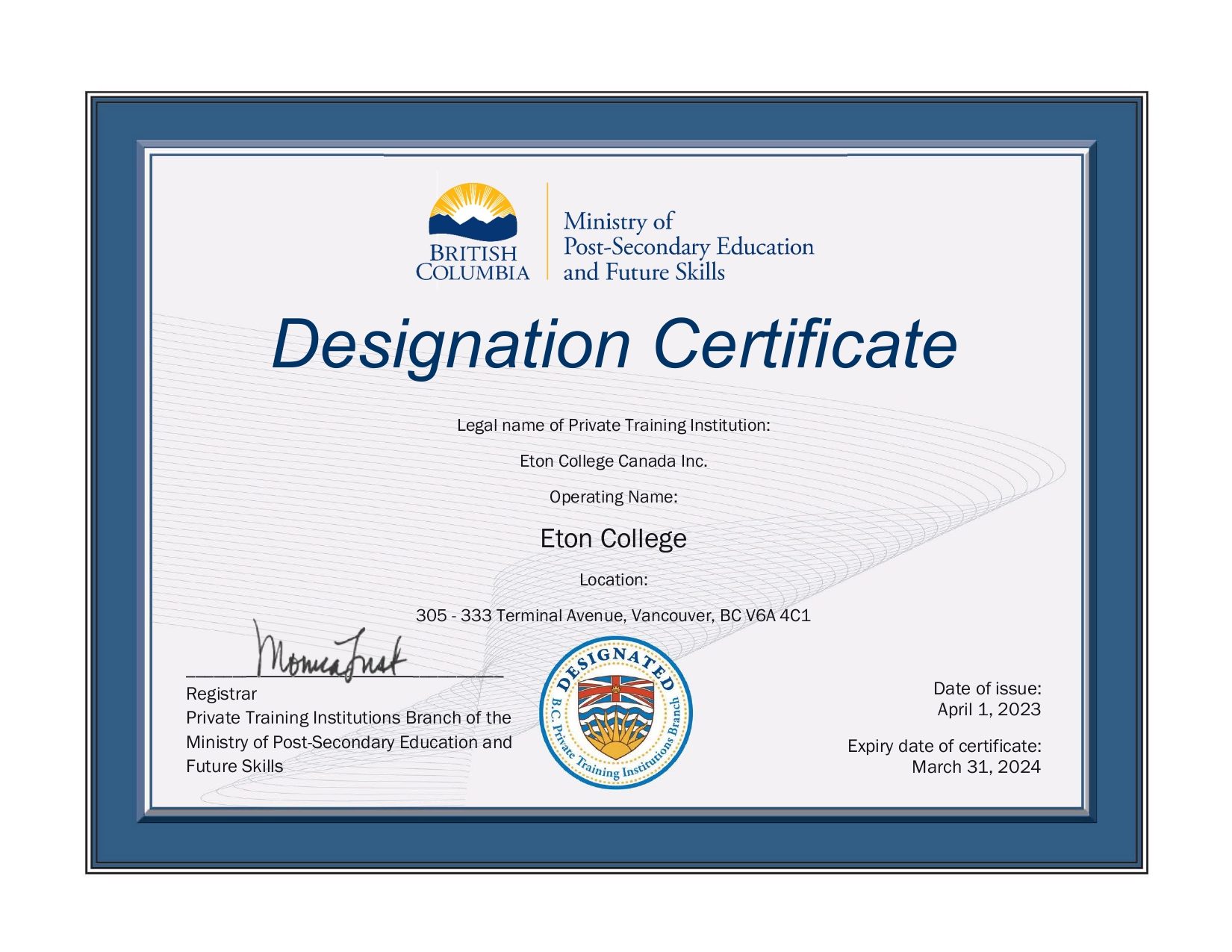
We are PTIRU-Certified!
Our Alumni Network
All Hospitality Programs
- Gulf of Georgia Cannery National Historic Site
- Holiday Inn Express
- Wedgewood Hotel & Spa
- Best Western King George Inn & Suites
- Rainbow Travel Inc
- H.I.S travel agency
- Vancouver International Travel Expo
- Element Hotels
- Sandman Hotels Group
- Rocky Mountaineer
- McDonald's
- Delta Hotels by Marriott
- Vancouver Aquarium