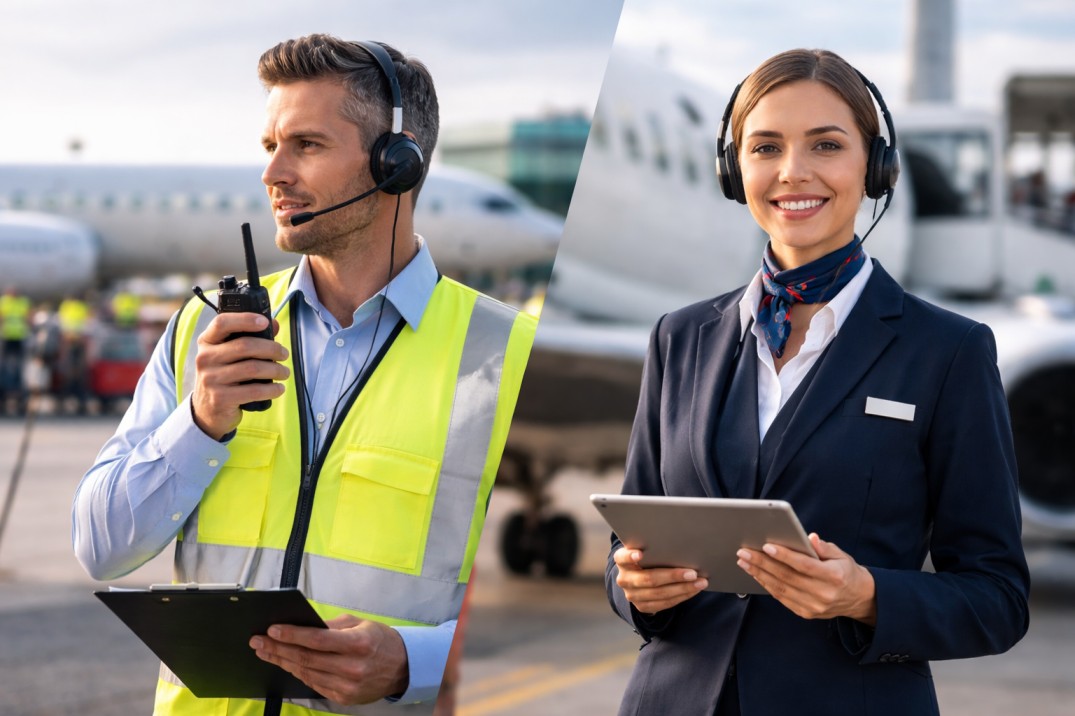
You’ll hear people say “airport operations” and “airline ground staff” almost interchangeably. They’re both part of the aviation world, sure. No doubt both work at airports, yes, but the kinds of work and roles they handle are completely different.
Airport operation is more like the system running in the background, the part you don’t see, but everything depends on that. It keeps things moving, keeps them safe and keeps them on time.
On the other hand, airline ground staff are right there in front of you. They are the ones who talk at the counter, the ones helping you with your boarding passes, your bags, and your questions when something feels confusing.
Let’s understand the roles and responsibilities of both the professionals briefly under this guide.
What are airport operations?
Airport operation is a broad and high-level function that ensures the system works smoothly so that planes can land, park, and depart safely. They are actively working on:
- Terminal management
- Security coordination with authorities
- Runway safety checks
- Movement of aircraft on the ground
- Scheduling and capacity planning
They deal with logistics so complex that one missed signal could delay flights for hours.
Airport operations are really about keeping everything in sync; it is not limited to just one airline or one task. They are involved in coordination, safety, and efficiency across the entire airport infrastructure.
What Is Airline Ground Staff?
Airline ground staff are the ones you see when you step inside that terminal. They are involved in the work that most travelers care about, like:
- Checking you in
- Issuing boarding passes
- Handling your baggage
- Helping you through boarding gates
- Answering questions about delays or flight changes
These are passenger & flight support roles. They are directly interacting with travelers and airlines. You could say, they’re someone who makes travel predictable for everyday folks, such as ticketing executives, customer service aides, baggage handlers, and ramp agents all focused on making your personal travel experience smooth.
The job is very hands-on, everything happens in real time, and honestly, sometimes it becomes stressful too. You’re dealing with passengers who might be tired and confused or in a hurry. These situations need quick thinking.
Key Differences Between Airport Operations and Airline Ground Staff
To help you understand this clearly, here’s a comparison table that explains these differences easily:
| Aspect | Airport Operations | Airline Ground Staff |
| Purpose | Coordination of airport systems, safety, infrastructure | Direct service & support roles interacting with travelers and hands‑on ground duties |
| Main environment | Behind‑the‑scenes planning rooms & control centers | Terminal counters, gates, baggage areas |
| Core skills | Strategic planning, safety protocols, coordination | Customer service, communication, and real‑time problem solving |
| Interaction with passengers | Indirect | Direct, every day |
| Career path | Airport management, senior operations roles | Service roles like check‑in agents, baggage handlers, ramp staff |
| Authority level | High, overarching airport functions | Medium, assigned airline, or ground handling company tasks |
Which Career Path Should You Choose?
If you’re confused between the two, let’s clear this up by one simple question.
Do you enjoy solving and figuring out how things work behind the scenes, or do you like interacting with passengers and solving their problems? Airport operations is for you if you like leadership, planning, and working behind multiple teams.
And ground staff is for you if you’re a people person and you like helping travelers, handling their tickets, checking bags, talking on headsets, and moving around airports.
And honestly, both can grow into each other over time. Many ground staff start in service roles and, with experience, move into supervision or operational planning if they choose further training.
Here’s what differentiates it in the long run:
- Management vs Service Orientation
- Technical Coordination vs People Interaction
- Higher-level Responsibility vs Front-line Operational Roles
Training Pathways for Each Career Option
These two paths don’t just feel different; the training you need is different too.
For airport operations, you usually need:
- Aviation management degrees (like BBA Aviation)
- Operational systems training
- Safety & compliance certification
- Leadership modules
For airline ground staff, most entry‑level roles start with:
- Diploma/certificate in aviation or ground services
- Customer service training
- Hands‑on baggage and ramp training
- Communication and soft skill development
In Canada, for example, you’ll find well‑structured aviation programs and entry courses that help prepare students for both tracks. They range from airport operations courses to passenger service management programs that build both practical and theoretical knowledge needed in 2026 job markets.
Training for airport operations tends to be more systems and regulations-focused, while ground staff training is more service and logistics oriented.
Aviation Training Options in Canada
Canada has become one of the most respected places for aviation training not just because of its global airline connections, but also because of how the schools integrate theory and hands-on industry practice.
Institutes there offer pathways tailored for the following:
- Airport operations
- Airline ground support
- Safety & compliance
- Customer & Passenger Experience Management
These structured programs prepare you for real scenarios like simulations for aircraft turnaround or real terminal customer service training and give you a solid foundation before you ever step foot in a live airport scenario.
At Eton we not only give you training but also a strong network and career guidance in aviation careers.
Conclusion
So, by now you are clear with the real difference between airport operations and airline ground staff.
If you understand it simply, airport operations function as the backbone of the airport, focusing on planning, coordination, safety, and ensuring that every system runs efficiently. On the other hand, airline ground staff are the people who you actually see and interact with.
Both roles are equally important but in a different way. One works behind the scenes to keep operations and everything in place, while the other makes sure that passengers feel everything is in place.
And if you are serious about building a career in this space, the right kind of training makes all the difference. It gives your career a new direction.
The program offered by Eton can be a good starting point in both operational knowledge and service excellence, helping beginners transition confidently into the aviation industry.
FAQs
- Are airport operations higher posts than ground staff?
Yes, as airport operations deal with broader systems and management of the entire airport’s functioning while ground staff focuses on specific task oriented services.
- Which has better long‑term growth?
Operational roles often open doors to leadership pathways and higher salaries over time.
- Do both roles require special training?
Yes, but airline ground staff may start with short certificate courses, while airport operations usually involve longer, more managerial training. For more information you can check out courses at Eton’s website.